Criticisms
Hurricane Andrewedit
In August 1992, Hurricane Andrew struck the Florida and Louisiana coasts with 165 mph (265 km/h) sustained winds. FEMA was widely criticized for its response to Andrew, summed up by the famous exclamation, "Where in the hell is the cavalry on this one?" by Kate Hale, emergency management director for Dade County, Florida. FEMA and the federal government at large were accused of not responding fast enough to house, feed and sustain the approximately 250,000 people left homeless in the affected areas. Within five days the federal government and neighboring states had dispatched 20,000 National Guard and active duty troops to South Dade County to set up temporary housing. This event and FEMA's performance was reviewed by the National Academy of Public Administration in its February 1993 report "Coping With Catastrophe" which identified several basic paradigms in Emergency Management and FEMA administration that were causes of the failed response.
FEMA had previously been criticized for its response to Hurricane Hugo, which hit South Carolina in September 1989, and many of the same issues that plagued the agency during Hurricane Andrew were also evident during the response to Hurricane Katrina in 2005.
Additionally, upon incorporation into DHS, FEMA was legally dissolved and a new Emergency Preparedness and Response Directorate was established in DHS to replace it. Following enactment of the Post Katrina Emergency Management Reform Act of 2006 FEMA was reestablished as an entity within DHS, on March 31, 2007.
Southern Florida Hurricanesedit
South Florida newspaper Sun-Sentinel has an extensive list of documented criticisms of FEMA during the four hurricanes that hit the region in 2004. Some of the criticisms include:
- When Hurricane Frances hit South Florida on Labor Day weekend (over 100 miles north of Miami-Dade County), 9,800 Miami-Dade applicants were approved by FEMA for $21 million in storm claims for new furniture; clothes; thousands of new televisions, microwaves and refrigerators; cars; dental bills; and a funeral even though the Medical Examiner recorded no deaths from Frances. A U.S. Senate committee and the inspector general of the Department of Homeland Security found that FEMA inappropriately declared Miami-Dade county a disaster area and then awarded millions, often without verifying storm damage or a need for assistance.
- FEMA used hurricane aid money to pay funeral expenses for at least 203 Floridians whose deaths were not caused by the 2004 hurricanes, the state's coroners have concluded. Ten of the people whose funerals were paid for were not in Florida at the time of their deaths.
Hurricane Katrinaedit
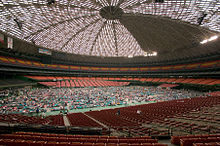
FEMA received intense criticism for its response to the Hurricane Katrina disaster in August 2005. FEMA had pre-positioned response personnel in the Gulf Coast region. However, many could not render direct assistance and were only able to report on the dire situation along the Gulf Coast, especially from New Orleans. Within three days, a large contingent of National Guard and active duty troops were deployed to the region.
The enormous number of evacuees simply overwhelmed rescue personnel. The situation was compounded by flood waters in the city that hampered transportation and poor communication among the federal government, state, and local entities. FEMA was widely criticized for what is seen as a slow initial response to the disaster and an inability to effectively manage, care for, and move those who were trying to leave the city.
Then-FEMA Director Michael D. Brown was criticized personally for a slow response and an apparent disconnection with the situation. Brown would eventually be relieved of command of the Katrina disaster and soon thereafter resigned.
According to the U.S. House of Representatives Select Bipartisan Committee to Investigate the Preparation for and Response to Hurricane Katrina:
- "The Secretary Department of Homeland Security should have designated the Principal Federal Official on Saturday, two days prior to landfall, from the roster of PFOs who had successfully completed the required training, unlike then FEMA Director Michael Brown. Considerable confusion was caused by the Secretary's PFO decisions."
- "DHS and FEMA lacked adequate trained and experienced staff for the Katrina response."
- "The readiness of FEMA's national emergency response teams was inadequate and reduced the effectiveness of the federal response."
- "Long-standing weaknesses and the magnitude of the disaster overwhelmed FEMA's ability to provide emergency shelter and temporary housing."
- "FEMA logistics and contracting systems did not support a targeted, massive, and sustained provision of commodities."
- "Before Katrina, FEMA suffered from a lack of sufficiently trained procurement professionals."
Other failings were also noted. The Committee devoted an entire section of the report to listing the actions of FEMA. Their conclusion was:
For years emergency management professionals have been warning that FEMA's preparedness has eroded. Many believe this erosion is a result of the separation of the preparedness function from FEMA, the drain of long-term professional staff along with their institutional knowledge and expertise, and the inadequate readiness of FEMA's national emergency response teams. The combination of these staffing, training, and organizational structures made FEMA's inadequate performance in the face of a disaster the size of Katrina all but inevitable.
Pursuant to a temporary restraining order issued by Hon. Stanwood R. Duval, United States District Court Judge, Eastern District of Louisiana as a result of the McWaters v. FEMA class-action, February 7, 2006 was set as the deadline for the official end of any further coverage of temporary housing costs for Katrina victims.
After the February 7 deadline, Katrina victims were left to their own devices either to find permanent housing for the long term or to continue in social welfare programs set up by other organizations. There were many Katrina evacuees living in temporary shelters or trailer parks set up by FEMA and other relief organizations in the first months after the disaster hit, but much more were still unable to find housing.
In July 2007, ice that had been ordered for Katrina victims but had never been used and kept in storage facilities, at a cost of $12.5 million, was melted down.
In June 2008, a CNN investigation found that FEMA gave away about $85 million in household goods meant for Hurricane Katrina victims to 16 other states.
Buffalo snowstormedit
FEMA came under attack for their response to the October Surprise Storm in Buffalo, New York, on October 13, 2006. As FEMA legally cannot interfere with state business unless asked, FEMA responded that as per procedure, the governor of the state of New York, George Pataki, had not asked for FEMA's assistance. FEMA Headquarters had been in constant contact with State congressional offices providing them with the latest information available. Claims state that FEMA officials did not arrive until October 16, three days after the storm hit. The snowstorm damage by this time included downed power wires, downed trees, and caused structural damage to homes and businesses.
Dumas, Arkansas tornadoesedit
Many people of Dumas, Arkansas, especially victims of tornadoes on February 24, 2007, criticized FEMA's response in not supplying the number of new trailers they needed, and only sending a set of used trailers, lower than the needed quantity. Following the storm, U.S Senator Mark Pryor had criticized FEMA's response to the recovery and cleanup efforts.
California wildfiresedit
FEMA came under intense criticism when it was revealed that a press conference on the October 2007 California wildfires was staged. Deputy Administrator Harvey E. Johnson was answering questions from FEMA employees who were posing as reporters. Many of these questions were "softball" questions (i.e., "Are you happy with FEMA's response so far?"), intentionally asked in a way that would evoke a positive response giving the impression that FEMA was doing everything right. In this way, any scrutiny from real reporters (many of whom were only given a 15-minute notice) would have been avoided. Fox News, MSNBC, and other media outlets aired the staged press briefing live. Real reporters were notified only 15 minutes in advance and were only able to call into a conference line, which was set to "listen-only" mode. The only people there were primarily FEMA public affairs employees.
Hurricane Mariaedit
In September 2017, Hurricane Maria struck Dominica and Puerto Rico with 175 mph (280 km/h) sustained winds. Maria was the fifth-strongest storm to ever strike the United States with stronger winds than those brought by Irma and similar rain brought to Houston by Hurricane Harvey. Despite FEMA's preemptive efforts in Puerto Rico, the island was still devastated beyond expectation. The agency had prepared some provisions for displaced residents before the storm struck, including: roughly 124 FEMA staff members being positioned on the island, food, water, and bedding. However, people reported the FEMA food packages were unhealthy snacks such as the confectionery Skittles. FEMA was widely criticized for its response to Maria, as the island quickly fell into a humanitarian crisis.
The island also experienced a massive loss of power as a result of flood and wind damage sustained during Maria. In the beginning of October 2017, Lieutenant General Todd Semonite, chief and commanding general of the United States Army Corps of Engineers, explained the extent of and necessity of aid for this power crisis. Semonite described some specifics of the outage to reporters, explaining that the island requires "2,700 megawatts of electricity to operate and at last count had 376 megawatts available." This translates to about 14 percent of the grid being functional.
FEMA Administrator William "Brock" Long told reporters in a briefing following the storm that Puerto Rico politics had hindered the ability of the federal government to send aid. He explained that political divisions had prevented unity for leaders in this time of crisis, describing that their issue was "even worse" than the mainland United States' issue between Democrats and Republicans. Residents, in some cases, were required to fill out paperwork in English rather than Spanish with little to no hope of receiving the aid they had requested.
Brigadier General Jose Reyes of the Puerto Rico National Guard discussed a strategy to quicken the arrival of resources via the Port of Ponce, located on the southern coast of Puerto Rico. Reyes also attributed the delay in these services to the unprecedented series of storms that demanded attention from the agency within a short period of time. Regarding this, General Reyes told reporters " We were not even getting back on our feet after Irma, then suddenly we got hit by Maria." He also addressed the disparities between aid sent to mainland disaster-stricken areas and Puerto Rico, explaining that in areas such as Florida and Texas, who had recently struck with similar damages, transportation of resources is relatively simpler. This is because they are able to utilize infrastructure to transport aid. Transporting similar resources to Puerto Rico has proved to be more difficult, as they must travel across the ocean, either in aircraft or in ships. Long also mentioned that Puerto Rico's international airport was not able to operate at full capacity, which posed an additional obstacle for federal aid imports.
Long resigned on March 8, 2019, following criticism of his handling of Hurricane Maria and an ethical complaint over misuse of official vehicles, costing $151,000. Homeland Security Secretary Kirstjen Nielsen said that Long would have to reimburse the government for the cost of the vehicles and staff involved in the trips, many of which were between Washington and his home in North Carolina. Neilsen submitted her own resignation as Secretary of Homeland Security less than a month later on April 7, 2019.
Hurricane Harveyedit
Hurricane Harvey made landfall in late August 2017 as a Category 4 Hurricane with 130 mph (215 km/h) sustained winds. The Hurricane predominantly affected southeast Texas; however, its effects were felt as far as Arkansas, Kentucky, and Tennessee in the form of flash flooding. Harvey slowly progressed around southeast Texas, where it produced heavy precipitation over the region. This caused heavy flooding in residential areas such as Colorado City, Liberty, and Montgomery, Texas.
Harvey was the first of a series of hurricanes and tropical storms to affect the United States between August and September 2017. The effects of these storms included extreme flooding, damage from high speed winds, structural damage, and humanitarian concerns regarding the availability of basic necessities such as food, water, and shelter.
Some recipients were forced to wait up to two months before receiving aid from FEMA, as technical complications held up both their application for it and the processing of said applications. Some residents were denied Federal Aid and have to dispute their denial in efforts to rebuild and repair properties without taking a considerably large financial loss.
edit
In early April 2020, the Los Angeles Times reported that the Trump administration was "quietly" seizing medical supplies from states and hospitals, citing hospital and clinic officials catering to seven states. These officials stated that the administration has not informed them how they can otherwise get access to their ordered supplies. A FEMA representative said the agency, working with the Department of Health and Human Services and the Department of Defense, has developed a system for identifying needed supplies from vendors and distributing them equitably. The federal government also seized an order for thermometers meant for Florida, an order for masks from the Texas Association of Community Health Centers, and an order for testing supplies meant for the PeaceHealth hospital system in Washington, Oregon and Alaska. On April 24, San Francisco Mayor London Breed said "We've had situations when things we've ordered that have gone through Customs were confiscated by FEMA to be diverted to other locations. We know everyone is dealing with a serious challenge. Through Customs, we've had situations where those items have been taken and put out on the market for the highest bidder, putting cities against cities and states against states." Massachusetts Secretary of Health and Human Services Marylou Sudders cited a shipment of 3 million masks that the state had negotiated to buy from BJ's Wholesale Club, until the federal government impounded them from the Port of New York and New Jersey on March 18. A further order from MSC Industrial Supply for 400 masks to be delivered on March 20 was also claimed by the federal government using force majeure. Massachusetts Governor Charlie Baker reached out to the New England Patriots professional American football team, who used the team plane "AirKraft" to bring approximately 1.2 million N95 masks from China to Boston. The state of Colorado was set to purchase 500 ventilators before the Federal Emergency Management Administration swooped in and bought them first. Trump announced on Twitter that the federal government would be sending 100 ventilators to Colorado at the request of Senator Cory Gardner. The incident caused Colorado Governor Polis to make future supply purchases in secret.
In late April, 5,000,000 masks meant for hospitals of the Veterans Health Administration were seized by FEMA and redirected to the Strategic National Stockpile, stated Richard Stone, Executive in Charge, Veterans Health Administration. After an appeal from Veterans Affairs Secretary Robert Wilkie to FEMA, the agency provided the VA with 500,000 masks.


Comments
Post a Comment