Response capabilities
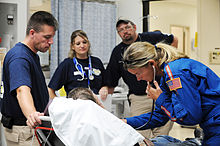
FEMA's emergency response is based on small, decentralized teams trained in such areas as the National Disaster Medical System (NDMS), Urban Search and Rescue (USAR), Disaster Mortuary Operations Response Team (DMORT), Disaster Medical Assistance Team (DMAT), and Mobile Emergency Response Support (MERS).
National Response Coordination Center (NRCC)edit
FEMA's National Response Coordination Center (NRCC) is a multiagency center located at FEMA HQ that coordinates the overall Federal support for major disasters and emergencies, including catastrophic incidents in support of operations at the regional level. The FEMA Administrator, or his or her delegate, activates the NRCC in anticipation of, or in response to, an incident by activating the NRCC staff, which includes FEMA personnel, the appropriate Emergency Support Functions, and other appropriate personnel (including nongovernmental organization and private sector representatives). During the initial stages of a response, FEMA will, as part of the whole community, focus on projected, potential, or escalating critical incident activities. The NRCC coordinates with the affected region(s) and provides needed resources and policy guidance in support of incident-level operations. The NRCC staff specifically provides emergency management coordination, planning, resource deployment, and collects and disseminates incident information as it builds and maintains situational awareness—all at the national-level. FEMA maintains the NRCC as a functional component of the NOC for incident support operations.
An example of NRCC activity is the coordination of emergency management activities that took place in connection with the 2013 Colorado floods.
Disaster Medical Assistance Teamsedit
Disaster Medical Assistance Teams (DMAT) provide medical care at disasters and are typically made up of doctors and paramedics. There are also National Nursing Response Teams (NNRT), National Pharmacy Response Teams (NPRT) and Veterinary Medical Assistance Teams (VMAT). Disaster Mortuary Operational Response Teams (DMORT) provide mortuary and forensic services. National Medical Response Teams (NMRT) are equipped to decontaminate victims of chemical and biological agents.
Urban Search and Rescue (US&R)edit
The Urban Search and Rescue Task Forces perform rescue of victims from structural collapses, confined spaces, and other disasters, for example, mine collapses and earthquakes.
Mobile Emergency Response Support (MERS)edit
These teams provide communications support to local public safety. For instance, they may operate a truck with satellite uplink, computers, telephone, and power generation at a staging area near a disaster so that the responders can communicate with the outside world. There are also Mobile Air Transportable Telecommunications System (MATTS) assets which can be airlifted in. Also, portable cell phone towers can be erected to allow local responders to access telephone systems.
The first test of the national wireless emergency system by FEMA was broadcast to an estimated 225 million electronic devices at 14:18 EDT on 3 October 2018. The text message was accompanied by a flashing warning sign and warning tone. The president may direct FEMA to broadcast such alerts only for national emergencies or if the public is in danger. The facility may not be used for personal messages from the president. Mobile phone owners can not opt out of these warnings.
Preparedness for nuclear incidentsedit
On August 1, 2008, FEMA released "Planning Guidance for Protection and Recovery Following Radiological Dispersal Device (RDD) and Improvised Nuclear Device (IND) incidents", which provide an action guide in the case of radioactive contamination. This guidance is specified as action guide for Radiological Dispersal Devices (RDD) and Improvised Nuclear Devices (IND) involving high levels of radiation. According to the Federation of American Scientists, during the Cold War FEMA prepared assessments of the likely consequences of a full-scale Soviet nuclear attack on the United States for use in planning mitigation and recovery efforts. FEMA also prepared plans for evacuating major U.S. cities in response to a nuclear war, dubbed CRP-2B.
Trainingedit
FEMA offers a large number of training classes, either at its own centers, through programs at the state level, in cooperation with colleges and universities, or online. The latter are free classes available to anyone, although only those with U.S. residency or work eligibility can take the final examinations. More information is available on the FEMA website under the "Emergency Personnel" and "Training" subheadings. Other emergency response information for citizens is also available at its website.
FEMA runs the Incident Workforce Academy, a two-week emergency preparedness training program for FEMA employees. The first class of the academy graduated in early 2014.
The Training and Education Division within FEMA's National Integration Center directly funds training for responders and provides guidance on training-related expenditures under FEMA's grant programs. Information on designing effective training for first responders is available from the Training and Education Division. Emergency managers and other interested members of the public can take independent study courses for certification at FEMA's online Emergency Management Institute.
Emergency Management Institute training and certificationsedit
EMI offers credentials and training opportunities for United States Citizens. Note that students do not have to be employed by FEMA or be a federal employee for some of the programs. However, they do need to create a FEMA SID to take the final exams
EMI maintains a strategic partnerships with Frederick Community College. FCC has contracted with the Emergency Management Institute to provide college credit for the Independent Study Program (ISP). FCC offers eight specialized Letters of Recognition, an Undergraduate Certificate, and an Associate of Applied Science degree in Emergency Management.


Comments
Post a Comment